


Removing Bad Airbnb Reviews: An AI Guide
Updated: Mar 19
Earlier this year, Airbnb began using AI technology to handle disputes with guest reviews. (Interestingly, however, Airbnb never really formally announced the shift and has been vague about how AI is being used when asked about it.) To help us make sense of how this new tech is being used and what you can do to when making your case to a machine, we have tapped AI to draft this handy guide--except for this opening, which was written by me with help from other real live board members. The humans would also like to add that the opinions and suggestions included in this guide are not necessarily those of STRASA. --Shelley Galbraith, Chair
A negative Airbnb review can feel like a punch to your listing’s visibility, potentially tanking performance and making future guests more likely to leave negative feedback themselves. While you cannot completely avoid occasional bad reviews, getting an unfair or dishonest review removed is crucial for protecting your business.
The process has changed dramatically, shifting from human mediation to an automated system. Successfully removing a review now requires hosts to speak the language of AI by strictly adhering to policy terms and avoiding emotional arguments.
_______________________________________________________________
Part I: The Policy Foundation—When Airbnb Will Remove a Review
Airbnb establishes its review system to foster trust and ensure that feedback is authentic, trustworthy, and useful for the community. Reviews must adhere to three core principles: they should be unbiased, relevant, and follow Airbnb’s Review Policy.
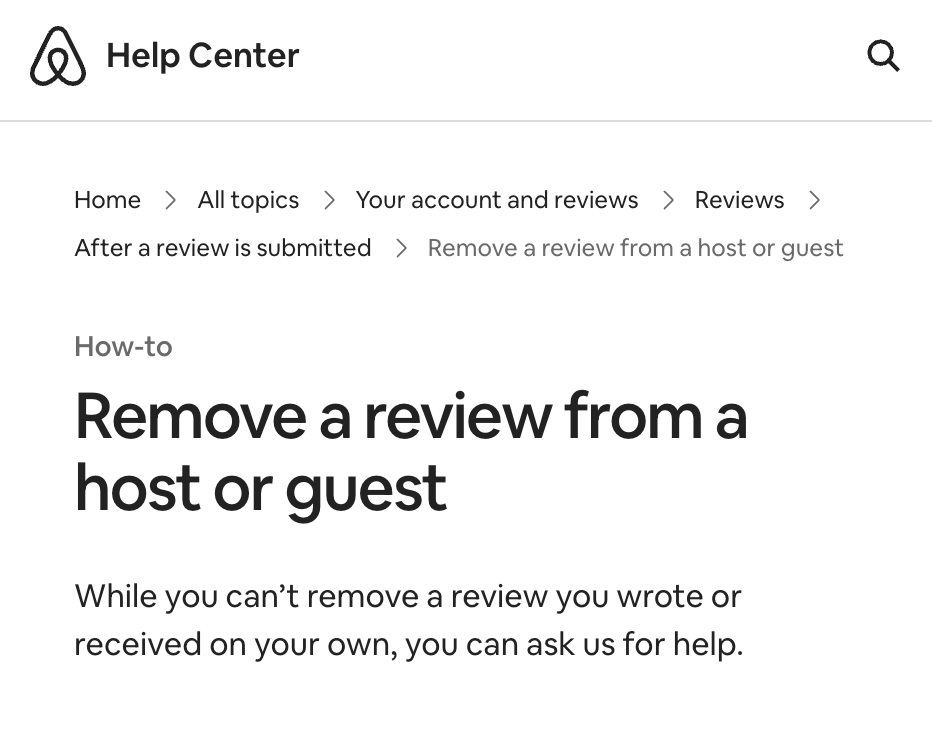
Airbnb will generally not mediate disputes concerning the truth of reviews or remove feedback simply because you disagree with the opinion, the star rating, or if it mentions issues outside your control. You cannot remove a review you received on your own; you must ask Airbnb for help.
Only certain individuals—such as the listing owner, a full access co-host, a team owner, or part of a guest management team—are eligible to request a review removal.
A review must violate one of the following specific policy grounds to be eligible for removal:
1. Reviews Should Be Unbiased
This category addresses manipulation and conflict of interest:
• Coercion or Extortion: Community members may not intimidate, threaten, extort, incentivize, or manipulate another person in an attempt to influence a review. This includes promising compensation in exchange for a positive review or threatening consequences for a negative review. Likewise, reviews may not be provided or withheld in exchange for something of value—like a discount, refund, or promise not to take negative action against the reviewer.
• Retaliation: Reviews may be removed if they are left in retaliation against a host who enforces a policy or rule.
• Genuine Stays: Reviews may only be provided in connection with a genuine stay, service, or experience. Hosts are not allowed to accept a fake reservation for a positive review, use a second account to leave themselves a review, or coordinate with others to manipulate the review system.
• Competition: Reviews cannot be used for the purpose of harming competition, such as posting biased reviews of competing listings.
2. Reviews Should Be Relevant
Reviews must provide information relevant to the reviewer's experience with the host, guest, stay, service, or experience. If a guest never arrived for their stay or had to cancel due to circumstances unrelated to that reservation, their review may be removed.
3. Reviews Should Follow the Content Policy
A review may be removed if it violates the content policy, meaning it contains explicit, discriminatory, harmful, fraudulent, illegal, or other prohibited content.
To report a violation, you submit a review removal request. The process involves selecting the review, choosing the reason for removal (such as "It’s retaliatory," "It involves pressure or coercion," or "It’s irrelevant"), providing details (up to 25,000 characters), and uploading supporting documentation. Airbnb will email a decision, usually within 48 hours.
_______________________________________________________________
Part II: The AI Fight—Modern Strategies for Removal
The Airbnb dispute process has shifted to be primarily AI-driven, meaning that initial decisions are made by an algorithm rather than human support agents. This change has been accompanied by a significant drop in success rates for disputes.
Since hosts are typically limited to one appeal attempt that is reviewed by AI, success depends on speaking in "computer logic" or "statement of fact" language. You must cut straight to the facts, avoiding emotional appeals or storytelling, as these are ignored by the AI filter.
The "Kitchen Sink" Strategy
To maximize the chance of getting past the AI filter, the recommended approach is the aggressive "Kitchen Sink" method:
1. Draft Statements of Fact: Write every possible claim in precise, this is true format language, eliminating leading language used to convince a human. For example: "Guest did not stay in the property. Guest does not qualify to leave a review because they were never there."
2. List All Violations: Construct a template listing every potential reason that could lead to removal, such as: guest never arrived, guest violated house rules (like smoking or quiet hours), guest attempted to extort the host, or guest made false statements to damage the business.
3. Submit the Full Template: On your first attempt, include the entire "kitchen sink" template, alongside your specific, case-related claims. Since you are communicating with a computer, your reputation is not at stake, and you should include as many claims as possible for the AI to process.
4. Create the Compliance Equation: Crucially, end your submission with a required action statement: “If any of these statements of fact are true, the review must be removed for any individual violation of Airbnb's terms of service.” This forces the computer to process multiple violations.
5. Attach Platform Proof: Always attach platform proof, such as at least one screenshot of messages or Resolution Center insights. Submitting evidence may push the case into a higher level of review, potentially bypassing the initial AI filter.
If selecting a reason for removal, choosing the option "It involves pressure or coercion" is often suggested as a high-stakes claim that might prompt a deeper review. Note that retaliation is specifically defined as punishment for enforcing a house rule, while denying a refund that leads to a bad review may be classified as coercion or incentivization.
The Final Option: Arbitration
For U.S. hosts, if a strong, policy-based claim is repeatedly denied by the AI system, the final option is to pursue arbitration (subject to the United States Dispute Resolution and Arbitration Agreement in the Terms of Service). According to some, this path potentially allows the host to blame Airbnb’s negligence, arguing that the AI-driven system breached the contractual guarantee of just and fair due process for dispute resolution, and potentially seeking punitive monetary damages.
_______________________________________________________________
Part III: Proactive and Responsive Mitigation
If a review cannot be removed because it does not violate policy (e.g., it is based on opinion, mentions things outside your control, or you simply disagree with the star rating), focus on mitigation and performance improvement.
1. Strategic Public Response
For a review you disagree with, a swift and professional public response is recommended to manage future guest perceptions.
• Respond quickly: It is best practice to reply within 24 hours.
• Use the Sandwich Method: Start positive (thanking the guest), address the concern factually without making excuses, and end positive (expressing hope for a return).
• Use the VAST Method: Another structured approach involves: Validate (acknowledge the feedback), Apologize (own the issue), Sympathize (relate to their disappointment), and Thank (show appreciation).
2. Bury the Review
The long-term strategy involves boosting your booking volume and subsequent positive reviews to push the negative feedback down the list. This may require adjusting your business settings:
• Adjust Pricing: Lowering prices can increase demand and help generate positive reviews faster.
• Increase Flexibility: Be more flexible with policies (e.g., allowing Instant Book, lowering minimum night stays) to attract more reservations quickly and amass good feedback.
In this current AI environment, surviving and cash-flowing means adapting to these difficult systems while maintaining the professionalism that attracts positive reviews.
_______________________________________________________________
Sources:


Comments